
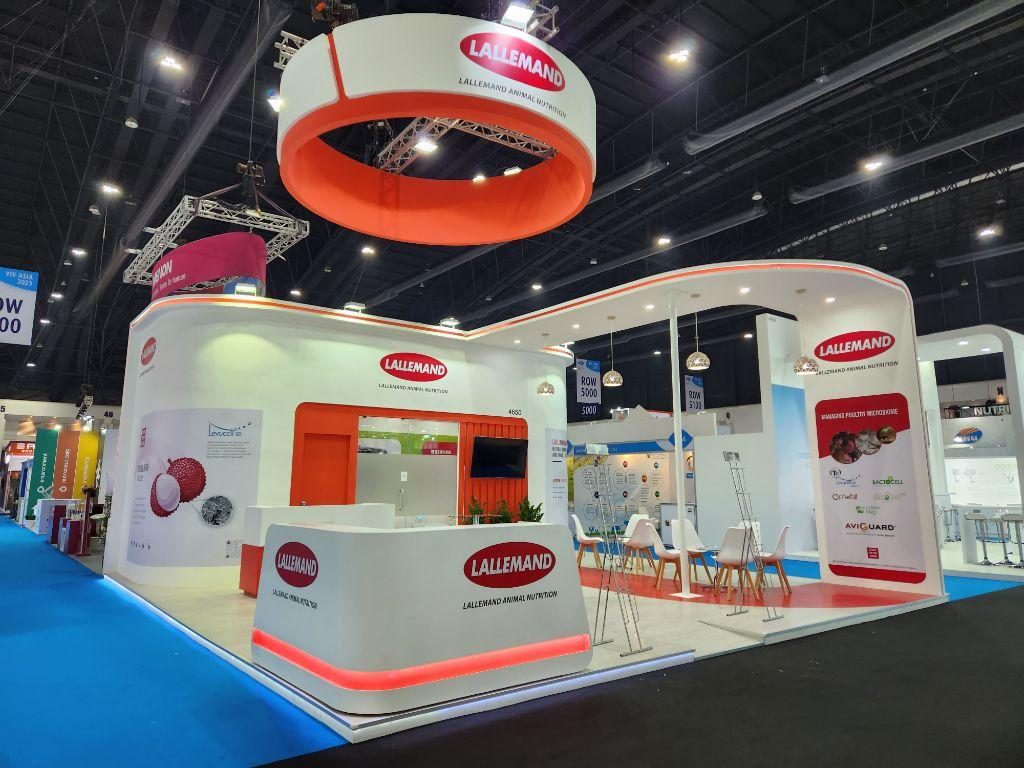
Inside Our Exhibition Stand Fabrication Workshop
The Workshop — Location and What Runs There
The Lam Luk Ka workshop handles carpentry and custom joinery, structural metalwork (steel welding and aluminium fabrication), surface finishing in the on-site spray booth, CNC routing, large-format rigid substrate printing and dye-sublimation fabric printing. Pre-assembly of complete stands before shipping is standard practice for every project — not a premium option. The same team that produces the fabrication drawings is the team that cuts the material.
Carpentry and Joinery
Carpentry is the primary material discipline for most custom exhibition stands. MDF is used for spray-finished flat surfaces; solid timber for edge banding and natural-finish elements; plywood in structural and joinery-critical applications. Joinery method — pocket screws, loose-tenon, biscuit, dowels — is selected for each joint based on the combination of load requirement and visual outcome. The joinery method is specified in fabrication drawings, not decided on the shop floor.
Metalwork
The workshop handles steel tube and flat bar welding, aluminium section cutting and drilling, and assembly of standard aluminium extrusion systems. Metal elements in exhibition stands appear as structural legs and frames, canopy and overhead structures, counter frames, door frames and decorative feature elements. Sections fabricated in the workshop are finished in-house with spray paint, powder coat preparation or brushed-metal film wrap.
Surface Finishing and the Spray Booth
Spray-finished surfaces — the painted walls, counters and feature panels that define the colour palette of most custom stands — are completed in the on-site spray booth. The process sequence is: substrate preparation, prime coat, fill, sand, prime, sand, topcoat. The number of cycles depends on substrate type and finish specification. High-gloss finishes require more preparation cycles than satin finishes. All surfaces are inspected under controlled lighting before proceeding to pre-assembly.
Pre-Build Inspection — Every Project, Before Every Show
Before any stand ships, it is assembled in full at the workshop. Every component — frame, wall panels, counter, lighting rig, graphics — is fitted together in the sequence the on-site crew will replicate at the venue. Issues found during workshop pre-assembly are corrected in the workshop in hours. The same issue at the venue, during the build-up window, adds pressure against a timeline with no available margin. The pre-assembly inspection is not an additional service — it is part of the standard production workflow for every project.
What Runs In-House vs What Is Subcontracted
| Discipline | Status | Notes |
|---|---|---|
| Carpentry and custom joinery | In-house | MDF, timber, plywood — all substrates |
| Steel welding and fabrication | In-house | Structural and decorative metalwork |
| Aluminium cutting and extrusion assembly | In-house | Section and modular frame systems |
| Spray painting and lacquering | In-house | On-site spray booth, all substrates |
| Large-format print — rigid substrates | In-house | Foam board, ACM, Dibond |
| Dye-sublimation fabric printing | In-house | Tension fabric, lightbox SEG panels |
| CNC routing | In-house | Profile cutting, lettering, shaped panels |
| On-site electrical connection | Subcontracted | Venue-approved licensed electrician, per show |
| AV equipment | Coordinated | Sourced, managed and installed — not manufactured |
What In-House Doesn't Mean
In-house capacity has a ceiling
One workshop handles a finite number of simultaneous projects. During peak Bangkok show seasons — broadly March to May and October to November — capacity constraints can extend fabrication timelines for projects briefed late. Projects confirmed early hold their production slot; late briefs compete with existing commitments.
Electrical work is subcontracted at every venue
On-site electrical connection at Bangkok venues requires a venue-approved licensed electrician. This is not a Pixelmate Exhibition Co., Ltd. employee. The electrician is coordinated by Pixelmate Exhibition Co., Ltd. as part of the project scope, but the electrical installation at the venue is the most common misunderstanding about what in-house capability covers.
Frequently Asked Questions
- Can I visit the workshop before confirming a brief?
- Yes. Workshop visits for prospective clients are welcome. Contact us to arrange a visit — we will confirm availability and show you work in progress.
- What is the largest stand you can pre-assemble at the workshop?
- The workshop accommodates stands up to approximately 400 sqm for pre-assembly, depending on configuration. Very large island stands may be assembled in sections rather than as a single unit — the sequence is documented for the on-site crew.
- Do you supply and manage AV equipment?
- AV equipment is sourced, managed and installed as part of turnkey projects. The equipment is specified and coordinated by Pixelmate Exhibition Co., Ltd. but is not manufactured or stocked by Pixelmate Exhibition Co., Ltd.. Sourcing is done per-project from vetted suppliers.
- Are there materials you cannot work with in-house?
- Glass installation, specialist stone cutting and large-format LED screen installation are handled by specialist subcontractors coordinated from the workshop. These appear in custom stand projects occasionally — they are not standard materials.
Pixelmate Exhibition Co., Ltd. has operated the Lam Luk Ka workshop since 2012. The workshop fabricates custom stands, modular systems, country pavilion components and graphics for exhibitions across Thailand and regional markets. If you have design drawings and need a fabricator, send them for quotation directly. For the full project scope from design through installation, see the custom exhibition stands page.
Compare your options
Ready to Plan Your Stand?
Send us your show name, floor space and brief — we return a fixed, itemised quotation and initial 3D concept within one working day, at no charge and no obligation.