
Exhibition Stands for Agriculture and Livestock Exhibitors
What Agriculture and Livestock Stands Need
Multi-hall presence management
Large agricultural companies often book across more than one show hall — feed in one, equipment in another, veterinary in a third. Managing a consistent visual identity across separate stand positions at the same show is a coordination challenge. Graphics, signage and any branded furniture must be producible in quantity and installable by the same crew on the same build-up timeline. The biggest failure mode is inconsistent branding between positions at the same show.
Heavy equipment display
Agricultural machinery — feeders, mixing systems, irrigation equipment, processing units — is heavy. Floor loading and crane access requirements apply as they do for manufacturing equipment. Equipment displayed statically requires plinths or platforms. Equipment that demonstrates requires power provision and, in some cases, safety barriers. Equipment dimensions and weight must be confirmed before the stand footprint is finalised.
Washdown practicality
Field equipment, veterinary products, feed samples and proximity to live animal areas all generate physical mess during a four-day show. Stands at VIV Asia should be designed for cleanability — smooth, non-porous surfaces, minimal crevices, no exposed fabric on surfaces that will be in contact with product. A stand that looks worn by day two in an agricultural environment is a predictable outcome of the wrong material specification.
Buyer meeting areas
Feed mill procurement managers, veterinary decision-makers and large livestock operation buyers expect a place to sit and review product specifications. The meeting requirement in the agriculture sector is formal — specification documents, technical comparison, order structure — even when the product is a compound feed rather than a pharmaceutical. A clearly defined buyer meeting area is as important here as it is in pharma.
Durability across show conditions
VIV Asia and Indo Livestock run over four to five show days with high footfall. Stand materials and finishes should be selected for durability under high-traffic conditions — solid timber or MDF for counters and display elements rather than lightweight print-and-fabric display systems that degrade under consistent contact.
Agriculture and Livestock Shows in Thailand
Regional livestock and feed industry reference, Jakarta
Companion animal and pet product industry, BITEC Bangkok
What We Build for Agriculture and Livestock
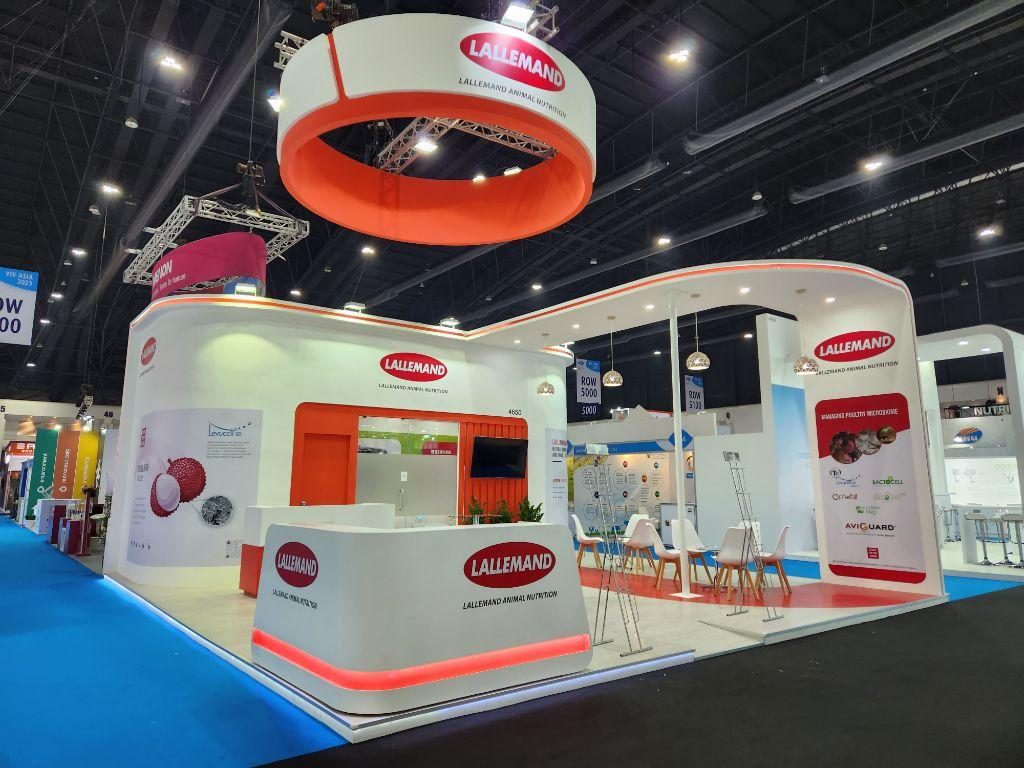
Agriculture and livestock stands built by Pixelmate Exhibition Co., Ltd. at Bangkok shows include multi-hall configurations at VIV Asia with coordinated graphics across two or more IMPACT hall positions, heavy equipment display platforms with load-spreading provisions, and washdown-resistant surface finishes throughout. The Lallemand stand at VIV Asia — visible in the portfolio — is one example from this sector, featuring a clean open-plan configuration designed to communicate a scientific ingredient brand clearly to a technically literate agricultural buyer audience at a large multi-hall show. Case studies documenting the full brief, constraint and build detail for this sector are being compiled.
View full portfolioWhat Goes Wrong at Agriculture Shows
Multi-hall logistics not coordinated
Graphics panels produced for hall one at the correct dimensions arrive for hall two where the panel format is different. Both stands need to open on the same build-up timeline. Co-ordinating multi-hall production and logistics requires a single project manager responsible for both positions — not two separate briefs to the same contractor.
Surface materials not selected for washdown conditions
Fabric-fronted counters, textured surfaces and painted MDF panels that are not sealed for moisture contact look visually degraded within one show day in agricultural conditions. Material selection should reflect actual show conditions, not showroom aesthetics.
Equipment footprint underestimated
Machinery arrives at the stand larger than the dimensions provided at the brief stage. The stand plan cannot accommodate it without blocking the aisle or removing a display element. Equipment dimensions and any assembly footprint beyond the static machine size must be provided and verified before the stand is designed.
Frequently Asked Questions
- Can Pixelmate Exhibition Co., Ltd. manage stands across multiple halls at the same show?
- Yes. Multi-hall stand management at VIV Asia and other Bangkok shows with multiple exhibition halls is handled as a single project with one project manager coordinating production, logistics and build-up across all positions.
- What surface finishes hold up best in agricultural show conditions?
- Powder-coated aluminium, sealed MDF with satin spray finish, and solid polymer countertops all perform well under high-traffic agricultural show conditions. Fabric-fronted display elements and open-grain timber surfaces are avoided on horizontal surfaces in high-contact areas.
- How are livestock proximity requirements managed in stand design?
- Where a stand is positioned adjacent to or in a hall also hosting live animals, surface materials, flooring choice and stand finishes are selected for cleanability and resistance to moisture and organic material. This is confirmed at the brief stage when the stand's hall position within the show floor plan is known.
Pixelmate Exhibition Co., Ltd. has built for agriculture and livestock exhibitors at Bangkok shows since 2012. For VIV Asia, Pet Fair South East Asia or any Bangkok agricultural show, send a brief covering your floor space, equipment list and any multi-hall requirements — we return a proposal within one working day.
Ready to Plan Your Stand?
Send us your show name, floor space and brief — we return a fixed quotation and initial 3D concept within one working day, at no charge and no obligation.