
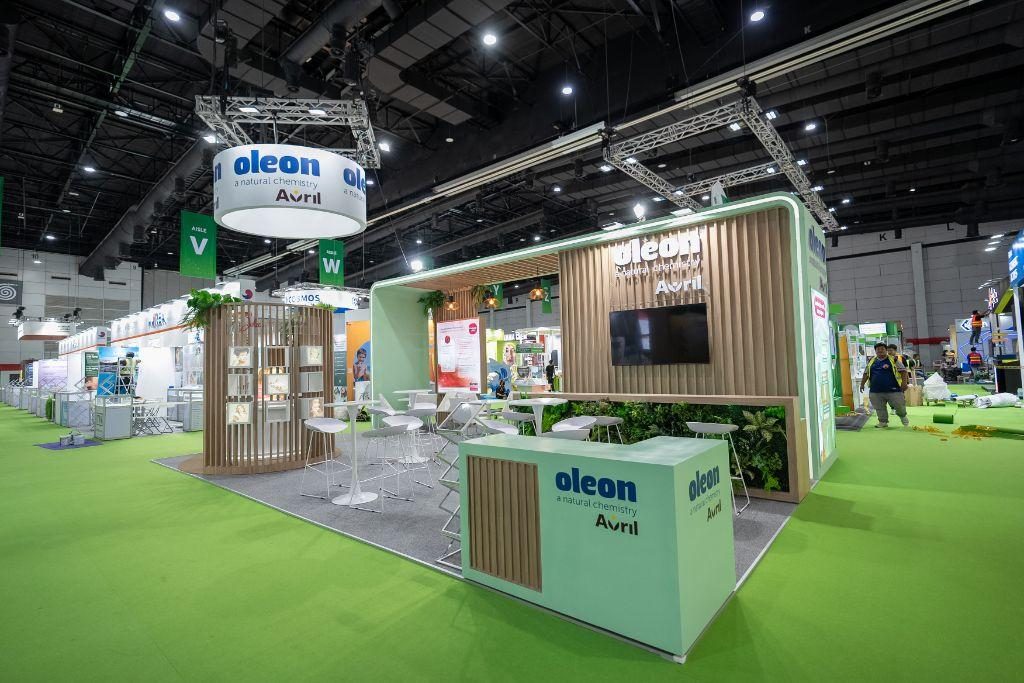
Backlit Lightbox Graphics That Stop Aisle Traffic
How Lightbox Systems Work
An exhibition lightbox is a rigid aluminium frame with a translucent fabric panel tensioned across its face and an LED light source behind it. The LED is either edge-mounted — light travels laterally across the back of the panel — or distributed across the full back surface. Edge-lit systems are thinner and lighter, making them easier to freight and faster to install. Full back-lit systems produce more even illumination across large panel areas, particularly at widths above 2.0 m.
The fabric panel attaches to the frame using a silicone edge strip pressed into a groove (SEG — Silicone Edge Graphic) or a simpler mechanical lock depending on the frame system. The SEG method is the current standard for exhibition lightboxes: it tensions the fabric cleanly across the face without visible hardware.
Dye-Sublimation Printing — Why It Matters for Backlit Use
Dye-sublimation transfers ink into polyester fabric fibres under heat and pressure. The result is a print that resists fading under continuous LED exposure, holds edge sharpness when the fabric is tensioned across a frame and produces better colour saturation under backlight than inkjet alternatives on vinyl or paper-based substrates.
The important technical point: colour as it appears on a dye-sublimated panel under front light differs from how it reads under backlight. Artwork prepared for backlit use should account for this shift — not by adjustment of the print file at the last step, but by designing for backlit viewing from the start. Artwork reprinted directly from a non-backlit version without adjustment will produce a different result under backlight than the reference.
Colour Under Hall Lighting
Bangkok exhibition venue hall lighting is predominantly metal halide or white LED. The practical effect: a backlit panel reads as a self-illuminated surface against the ambient-lit hall background — it is brighter than its surroundings regardless of the hall lighting colour temperature. Panels designed to work as self-contained backlit images, without depending on a surrounding lighting design, produce more consistent results across different hall environments.
Panel Sizes, Joins and Seam Management
Tension fabric for lightbox panels is produced from roll stock with a maximum single-piece width that depends on the print equipment — typically 3.2 m to 5.0 m. Lightbox panels wider than the available roll width require either a split across a centre frame rail (two panels, one visible rail at the join) or a seam within a single panel. For visual quality, splitting across a frame rail is preferred — the rail reads as a structural division rather than a fabric seam. Graphic layout for large-format lightboxes should account for the split position.
Where Lightboxes Work Hardest
The highest-impact positions for lightbox panels are full-height aisle-facing back walls, overhead header panels visible along the aisle from a distance, and column wraps at stand corners visible from two aisle directions simultaneously. A single full-height backlit back wall on a standard inline stand consistently outperforms the same graphic printed on a non-backlit substrate at the same size. Multiple coordinated lightbox elements produce cumulative aisle presence that reads clearly from the hall entrance.
Lightbox System Comparison
| System Type | Illumination | Panel Format | Typical Depth | Best Application |
|---|---|---|---|---|
| SEG edge-lit frame | Edge-mounted LEDs, light travels across panel | Tensioned fabric (SEG) | 60–100 mm | Standard walls and header panels |
| Full back-lit box | Full LED array behind panel | Tensioned fabric (SEG) | 150–200 mm | Large back walls requiring maximum evenness |
| Rigid lightbox panel | Full LED array behind rigid face | Translucent rigid substrate | 80–120 mm | Small to medium sizes, premium finish |
Power, Artwork and Reliability
Power allocation must be booked in advance
Lightbox systems draw more power than equivalent printed panels. LED systems are efficient but not zero-draw. Multiple lightbox elements require power allocation booked with the show organiser at the time of stand space registration. Power shortfalls discovered at build-up cannot be resolved quickly — the organiser's electrical contractor allocates circuits before build-up begins.
Backlit artwork is a separate preparation step
Artwork prepared for a non-backlit printed panel cannot be used unchanged for a lightbox panel without the risk of a different visual result under backlight. If your design agency has not prepared for backlit use, the artwork requires adjustment before it can be printed for a lightbox panel — this adds a step to the pre-show timeline.
LED driver failure — the most common technical issue
LED systems in current lightbox frames are reliable under normal operating conditions. The most common failure mode is a driver unit rather than individual LEDs — visible as a section of panel going dark. Replacement drivers are a standard stock item. The practical consequence is a minor build-up repair rather than a significant failure.
Frequently Asked Questions
- Can I replace the graphic between shows without replacing the frame?
- Yes. The SEG fabric panel unclips from the frame; a new panel clips in. Frame storage and fabric printing for repeat-use lightbox systems are both managed at the Lam Luk Ka workshop.
- What resolution should backlit artwork be prepared at?
- For dye-sublimation on lightbox fabric, 100 dpi at final print size is sufficient for panels above 1.0 m width. Smaller panels benefit from 150 dpi. Vector-origin artwork is preferable to raster-origin for type elements and sharp edges.
- Can a lightbox panel fit inside a shell scheme booth?
- Freestanding lightbox frames can be positioned within a shell scheme without attaching to the shell structure. Power comes from the shell scheme's allocated socket. The depth of full back-lit boxes (150–200 mm) constrains available floor space in small booths.
- How much additional power allocation does a lightbox system need?
- A standard 1.0 m × 2.5 m edge-lit SEG panel draws approximately 30–50 W. A full back-lit back wall at 3.0 m × 2.5 m draws approximately 100–150 W. Include this in the power booking at the time of stand registration.
Lightbox graphics produced at the Lam Luk Ka workshop are used in custom stands, modular systems and as standalone display additions at Bangkok trade shows. All panels are printed in-house by dye-sublimation and fitted to SEG frames supplied or coordinated by Pixelmate Exhibition Co., Ltd. For stands where lightbox graphics form part of a full build, the custom exhibition stands page covers the complete scope. Send your panel dimensions, stand positions and artwork status — we return a proposal within one working day.
Compare your options
Ready to Plan Your Stand?
Send us your show name, floor space and brief — we return a fixed, itemised quotation and initial 3D concept within one working day, at no charge and no obligation.