
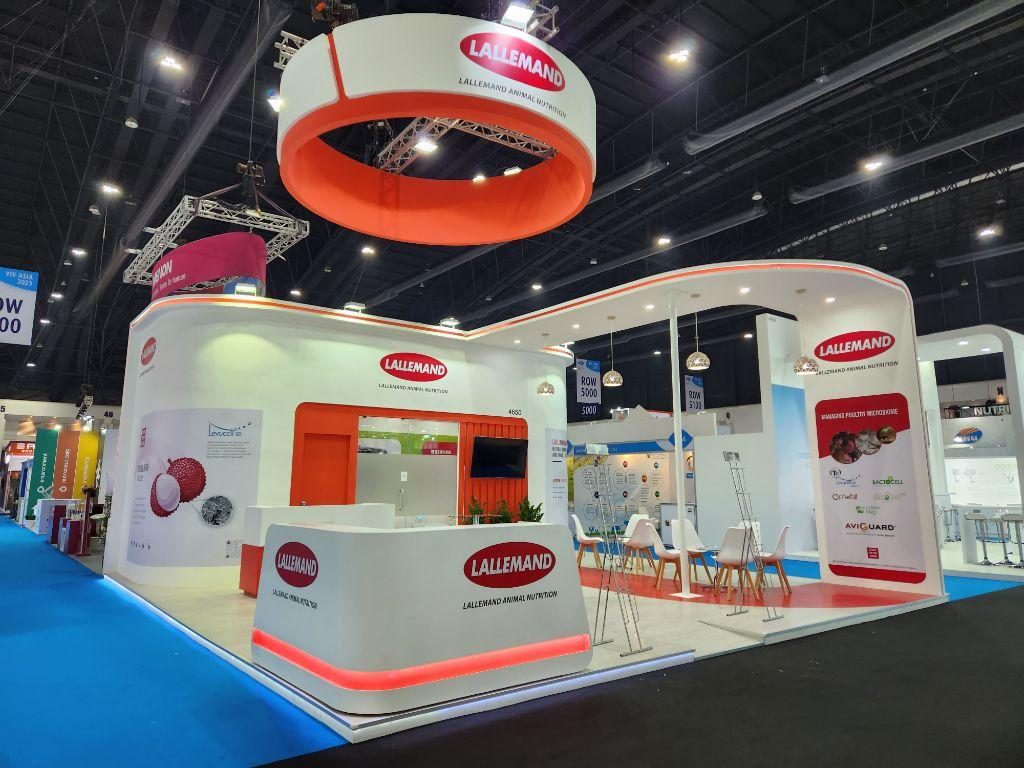
VIV Asia is the Asia-Pacific region's principal feed-to-food trade event, held at IMPACT Muang Thong Thani, Bangkok. Exhibitors represent the full livestock production chain — animal feed ingredients and compounds, veterinary health and pharmaceutical products, genetics and breeding technology, livestock housing equipment and agri-tech platforms. A stand at VIV Asia must communicate a clear technical category to an audience of producers, integrators and feed specialists who arrive with structured sourcing plans and cover multiple halls in a single visit.
Pixelmate Exhibition Co., Ltd. has designed and built stands at IMPACT Muang Thong Thani for exhibitors across sectors since 2012. This guide covers what a stand at VIV Asia 2027 specifically requires — hall dynamics, sector-appropriate formats, build requirements particular to this industry, and what this technically literate audience notices and responds to.
Who Exhibits at VIV Asia — and Who Comes to Visit
The VIV Asia exhibitor mix spans the full livestock supply chain: compound and ingredient feed manufacturers (amino acids, enzymes, organic acids, mycotoxin binders, premix systems), veterinary pharmaceutical and biological companies, genetics and breeding technology providers, livestock housing and automated equipment suppliers (feeding systems, ventilation, waste management), processing and slaughter technology companies, and precision agri-tech platforms covering data management and connectivity.
The visitor profile matches that range. Buyers and technical decision-makers attend from across Southeast Asia, South Asia, China and the Middle East — integrators managing large-scale poultry, swine or aquaculture operations; independent producers; feed mill procurement managers; veterinarians with purchasing authority; and distributors assessing new product lines. A significant proportion travel specifically for the show and arrive with pre-planned supplier lists. That means the audience at VIV Asia includes a high proportion of qualified buyers — and that a stand which fails to read clearly from 10 metres will be skipped by exactly those buyers.
IMPACT Muang Thong Thani — Hall Layout and Visitor Flow at VIV Asia
VIV Asia occupies multiple halls at IMPACT Muang Thong Thani, one of Southeast Asia's largest purpose-built exhibition complexes. Hall assignments typically reflect exhibitor category — feed and nutrition companies, equipment suppliers and technology providers are often grouped by sector, which concentrates relevant footfall around your immediate neighbours.
IMPACT's halls connect via internal corridors and a central connection structure. First-day morning traffic concentrates near the main registration and entrance points. Visitors who plan systematically reach outer halls by mid-morning; peak footfall in halls further from the entrance typically arrives later in the show day. Understanding where your assigned hall sits in the visitor's journey should directly inform stand design priorities — high-visibility open formats reward accessible positions; content-rich configurations work in quieter zones where visitors arrive with more specific sourcing intent.
IMPACT's exhibition halls have significant ceiling clearance — sufficient for double-deck structures and suspended graphics at most floor positions. Aisle widths are generous. That combination means stands compete across long sightlines: a brand headline that reads only from 5 metres is effectively invisible to the aisle traffic that determines whether a visitor stops.
Stand Formats for Feed, Animal Health and Agri-Tech Exhibitors
Livestock sector exhibitors have design considerations that distinguish them from consumer or professional-services shows. Visitors are technically literate — they read product categories, compound names and efficacy claims at a glance — but they also make split-second decisions about which stands merit a deliberate visit versus a passing look. The table below matches stand format to exhibitor type and primary objective.
Stand format options for VIV Asia exhibitors — IMPACT Muang Thong Thani
| Stand Format | Typical Floor Area | Best Suited For | Primary Design Priority |
|---|---|---|---|
| Open-front inline | 9–24 m² | Single-product suppliers, first show at VIV Asia | Clear category headline, product display counter |
| Corner stand | 18–40 m² | Multi-product ranges, regional distributors | Two open faces, defined sampling or demo zone |
| Peninsula stand | 36–72 m² | Multi-division companies, mid-size multinationals | Three open sides, enclosed meeting alcove |
| Island stand | 48–150+ m² | Multinationals, full product-range exhibitors | 360° category visibility, private meeting rooms |
| Double-deck island | 60+ m² footprint | Companies needing private upstairs meeting capacity | Open ground-level display, private first floor |
First-time exhibitors and single-product suppliers typically book 18–36 m² corner or inline positions. Mid-size multinationals with multiple product lines move into 48–72 m² peninsula or island configurations. Large equipment companies and full-range exhibitors book 80–150+ m² island or double-deck structures. The right size starts from the activities that must happen on the stand. Starting the timeline conversation early also gives more options — island allocations at popular shows sell out months in advance.
Build Requirements Specific to the Livestock and Agri-Tech Sector
VIV Asia exhibitors regularly have technical build requirements that are uncommon at consumer shows or pharmaceutical events. Identifying these during briefing allows the contractor to design around them rather than add them later at additional cost.
AV Integration and Live System Demonstrations
Agri-tech companies — precision livestock farming platforms, connected feeding systems, herd management data tools — need screen space integrated into the stand structure at a comfortable viewing height. At VIV Asia, screen content should be visible from outside the stand, not just from within a hospitality zone. Power at IMPACT is ordered through the show organiser before the event; standard shell scheme allocation is insufficient for multiple large displays or equipment demonstrations. Agree the electrical load plan with your contractor before finalising the layout.
Sampling Counters and Cold Storage
Feed ingredient exhibitors frequently run sampling programmes at VIV Asia. A purpose-built sampling counter — at the correct working height, with staff-side and guest-side access clearly separated — is a practical requirement, not a layout option. If samples are temperature-sensitive (probiotics, enzymes, biological products), refrigerated storage integrated below the counter adds complexity and requires a dedicated power circuit. A counter designed for sampling looks and functions differently to a reception counter designed for visitor greeting — the two should not be conflated in the design.
Heavy Equipment and Floor Loading
Livestock equipment companies bringing physical hardware — feeders, drinker systems, ventilation units, weighing platforms — need to confirm floor loading capacity with the organiser before stand design is finalised. IMPACT Muang Thong Thani publishes floor loading limits per hall. Concentrated point loads — the weight of equipment resting on a small ground contact area — can exceed the per-square-metre limit even when total weight appears acceptable. Load-spreading sub-flooring should be designed into the stand structure from the outset if heavy units are planned.
What a VIV Asia Audience Responds to on a Stand
VIV Asia visitors are typically experienced trade show attendees who have evaluated dozens of stands across multiple editions of this event. Generic brand banners and a brochure rack do not distinguish a company in an environment where competitors present with technical rigour.
The stands that generate sustained dwell time share specific characteristics. A clear visible product category — species focus, product type and key differentiator should all be readable from the main aisle before a visitor steps in. Active demonstration: a screen showing live system data, an enzyme activity visualisation, physical samples laid out and labelled, or a technical specialist available to engage immediately. Passive stands require the visitor to initiate contact; active stands remove that barrier.
Authority indicators carry particular weight in this sector. Independent efficacy data, regulatory approvals, research institution partnerships and species-specific trial results — presented as graphic panels, data screens or printed summaries rather than buried in a brochure — communicate seriousness to a specialist audience. A livestock producer sourcing a new feed additive is not persuaded by a large logo. They are persuaded by a technical claim they can examine. Comfortable seating and a surface to spread out documentation — even without a fully enclosed meeting room — converts initial interest into a proper conversation.
Planning Timeline for VIV Asia 2027
The sequence below assumes a custom exhibition stand built for VIV Asia at IMPACT. Modular systems that reuse an existing frame compress the timeline. For a first-time exhibitor at VIV Asia, or any stand requiring double-deck or venue structural submission, build in additional weeks at step 3.
- 1On space confirmation: contact a Bangkok contractor immediately and share the venue, hall and space dimensions. IMPACT's build-up windows for large shows require the contractor to be registered in the organiser system well in advance.
- 2Brief and concept: brief submitted; concept design and 3D visualisation in progress. Confirm at this stage whether your stand requires a venue structural submission — double-deck structures, raised platforms and suspended elements all do.
- 3Design sign-off: written approval releases fabrication. This is the critical date — every day's delay compresses the fabrication schedule.
- 4Structural submission: calculations completed and submitted to the organiser where required. Confirm the exact submission deadline with the VIV Asia organiser when you receive your exhibitor manual.
- 5Fabrication and inspection: fabrication complete; graphics printed, AV sourced and tested; pre-build inspection at the contractor's workshop. This is the client's last opportunity to inspect finishes and test lighting before the stand leaves the facility.
- 6Build-up window: installation crew at IMPACT. VIV Asia is a multi-day build for large stands; schedule your crew access times against the organiser's published build-up schedule.
- 7Show close: dismantling within the organiser's permitted I&D window. Confirm this before the show opens — overtime penalties for overrunning the dismantling window at IMPACT venues apply.
Frequently Asked Questions
Questions specific to exhibiting at VIV Asia 2027.
Stand sizes at VIV Asia range from 18–36 m² corner or inline spaces for first-time exhibitors and single-product suppliers, to 48–72 m² peninsula or island positions for mid-size multinationals, up to 80–150+ m² island or double-deck structures for large equipment companies and full-range exhibitors. The right size is determined by the activities the stand must support, not a round number.
Physical equipment can be displayed at IMPACT, but floor loading limits apply and vary by hall. Equipment with a small ground contact area can exceed the per-square-metre limit even if total weight appears acceptable. Confirm load requirements with the organiser and your contractor before finalising the stand design. Load-spreading sub-flooring should be built into the structure from the start if heavy units are planned.
Stands with structural elements above the venue's height threshold — and all double-deck structures, raised platforms and suspended or rigged elements — require submission to the organiser's technical team. The contractor prepares and submits the documentation. The deadline for VIV Asia typically falls six to eight weeks before build-up; confirm the exact date when your space is booked.
Livestock and agri-tech stands reward materials that signal technical credibility: clean timber or laminate surfaces in muted natural tones, aluminium framing, matte rather than high-gloss finishes. Backlit lightbox graphics read from distance in large halls and work across all exhibitor categories at VIV Asia. Avoid heavily decorative or consumer-retail finishes that look out of place in a B2B technical environment.
Power at IMPACT Muang Thong Thani is ordered through the show organiser, not the contractor. Forms are issued in the exhibitor manual after space booking. Stands with multiple screens, refrigerated storage, heavy AV or live equipment demonstrations need significantly more than the standard shell scheme allocation. Discuss the electrical load plan with your contractor before submitting the power order form.
VIV Asia 2027 at IMPACT Muang Thong Thani puts your stand in front of livestock producers, feed specialists and agri-tech buyers from across the Asia-Pacific region — an audience that is technically literate, actively comparison-shopping, and making purchasing decisions that run to significant commitments. A stand that communicates category clearly, enables product demonstration and supports structured one-to-one conversation delivers the conditions for those conversations to become business. Pixelmate Exhibition Co., Ltd. designs and builds stands for IMPACT shows from its own Lam Luk Ka fabrication workshop, handling design, graphics, AV, furniture, installation and project management as a single engagement. Send your show, hall and space details to receive a fixed, itemised quotation and an initial 3D concept.